
Here is an animated description of the Double-Slit Experiment that I made reference to in the previous class.
Showing posts with label Science. Show all posts
Showing posts with label Science. Show all posts
Monday, March 15, 2010
Double-Slit Experiment
Saturday, March 13, 2010
New X-Trials' Lesson for This Week
 Lesson 5b is obviously a continuation of Lesson 5a, the fifth worldview tour, "Science: What is True?" We continue to examine the case that fallen man ignores the plain evidence of objective scientific inquiry and promotes the atheistic philosophy of evolutionary theory primarily because he is determined to do as he pleases without answering to a higher authority.
Here is a preview of this weeks lesson:
You can watch the complete lesson here. Contact me (X-trials@BrianBorden.com) if you still need a Username and Password.
See you Thursday!
Wednesday, March 03, 2010
The Truth Project - Science: What is True?
In this, our fifth worldview tour we will establish yet another important pillar in the Temple of Truth: Science. In the process, we will discover that whereas “the heavens declare the glory of God and the firmament shows His handiwork” (Psalm 19:1) so that the Creator’s “invisible attributes are plainly seen” (Romans 1:20), mankind has nevertheless chosen to ignore the obvious truth, twisting scientific investigation into a vehicle for propagating a godless philosophy of human independence and self-determination.
Having completed our brief and cursory discussion of the nature and character of God, we turn now to consider a very different question: what does “the stuff in the box” really tell us when we honestly look at it? Dr. Tackett argues that scientific investigation – “the systematic study of the structure and behavior of the physical and natural world through observation and experiment” – is also a valid way of ascertaining truth. For when we open the box, we find that it is filled with voices that speak to us loudly about the majesty and power of the One who has created the physical universe. Everywhere we look – whether up at the grandeur of the stars and galaxies or deep into the tiny and elegantly designed inner workings of a living cell – there is evidence that the cosmos is the handiwork of an intelligent, rational mind. In the contemplation of nature, we come face to face with the truth that God exists and that He has revealed Himself to us, not only through His written Word (special revelation) but also through the works of His hands (general revelation).
Our natural reaction to this experience should be like that of a child: wonder, marvel, and praise for the Creator. But because of the effects of the fall and the polarizing influence of the Cosmic Battle, man shows a tendency to deny what is plain to the senses and to “exchange the truth of God for a lie” (Romans 1:25). Driven by this impulse, he transforms straightforward scientific inquiry, which properly concerns itself with particulars, into an all-embracing philosophy, which claims to establish universals on the basis of the “stuff in the box.” The result is the propagation of a worldview that “scientifically” excludes the Creator, thus “freeing” mankind from accountability to a higher authority.
Central to this philosophy are the assertions of Darwinian evolutionary theory. By keeping the details of creation’s story completely inside “the box,” evolution effectively rules out the existence of God. Herein lies the heart of the debate over “Intelligent Design.” Atheist C. Richard Bozarth actually goes so far as to claim that “evolution destroys utterly and finally the very reason Jesus’ earthly life was supposedly made necessary.” It is exactly this kind of philosophical assumption that inspires the visceral antagonism of evolutionists toward anyone who dares question the validity of their theory. This is why Darwinists so fervently assert that “evolution is no longer merely a theory, but an established fact.” But the truth of the matter, as Dr. Tackett and his guest experts demonstrate in great detail, is that the theory is not supported by the evidence. Many inside the scientific community are beginning to recognize this. But they dare not acknowledge it publicly because of the worldview issues at stake. As Dr. David Berlinski says, “The consequences are serious.”
The essence of Dr. Tackett’s message may be summed up as follows: fallen man ignores the plain evidence of objective scientific inquiry and promotes the atheistic philosophy of evolutionary theory primarily because he is determined to do as he pleases without answering to a higher authority.
Here is a preview of this weeks lesson:
You can watch the complete lesson here. Contact me (X-trials@BrianBorden.com) if you still need a Username and Password.
See you tomorrow!
Friday, November 28, 2008
Picture of the Enemy

Check out Boston.com's big pictures of the micro world. Some great shots. Also take a look at their The Big Pictures page which shows today's world and news in photographs. The photo above is a close up shot of pollen from a variety of plants.
First Images of 2 Planets Outside Our Solar System
We've been able to calculate that there are planets around other stars but these are the first direct images of not 1, not 2, but 3 exoplanets. It is an absolutely amazing feat and one that not too long ago was considered almost impossible. We'll it seems that the "almost" was the key here. Here's the story from Phil Plait's Bad Astronomy blog.
This is incredible: For the first time, ever, astronomers have captured an optical image of a planet orbiting a star like our own.
And that’s not all: we also have a second picture showing TWO planets orbiting a second star!
(Calm down. Breathe, breathe.)
The first picture is from Hubble. Ready? Here it is:
Do you see it? That tiny spark, that wee blip of light? It may not look like much, but it is in fact a normal planet orbiting a normal star, 250 trillion kilometers from Earth.
Holy Haleakala.
The picture as a whole needs some splainin’. The star in question

is Fomalhaut, a star easily visible to the unaided eye; it’s the brightest star in the constellation of Piscis Austrinus, the 18th brightest in the sky, and only 25 light years away. It’s literally millions of times brighter than the planet, so the Hubble camera uses an occulting bar, a small piece of metal that blocks the brightest part of the star’s image. The blacked-out area in the center of the picture is where Fomalhaut is (also, the star’s image has been digitally subtracted using an image of another star as a template; that further reduces the amount of unwanted light). The radial lines are not real; they are an optical effect of the very bright star. The ring is real; it’s dust leftover from the formation of the star and the planet. In fact, the thinness of the ring was a big factor in assuming a planet was lurking there; the planet’s gravity sculpts the ring, keeping it narrowly confined. Also, the ring is off-center from the star, and a planet in an elliptical orbit would explain that nicely.
The planet itself is just that small dot, almost lost in the noise from the star and the light from the ring. I’ll be honest; had I been analyzing the image, I might have missed it at first. But it’s there, and it’s real. Images taken almost two years apart show that the planet is moving with the star, and is consistent with it orbiting Fomalhaut at a distance of about 18 billion km (11 billion miles). That’s four times the distance of Neptune from the Sun. It takes 872 years to make one complete orbit. The mass is not easy to determine, and is estimated using its effect on the ring; it’s likely to be about the same size and mass as Jupiter.
The planet is unnamed, and is simply called Fomalhaut b.
I am reeling from this image. Years ago, when I still worked on Hubble, I did some work on planetary debris rings like this, including seeing if we could directly see planets near stars. The amount of work that goes into this type of discovery is phenomenal, and so I’m stunned by the success of it.
This is huge news.
And it gets even huger. Because there’s more:

That image is the first to directly show two planets orbiting another star! It’s a near-infrared image using the giant Gemini North 8 meter telescope. Like in the Hubble image, the star’s light has been blocked, allowing the two planets to be seen (labeled b and c).
The star is called HR 8799. It’s a bit more massive (1.5 times) and more luminous (5x) than the Sun, and lies about 130 light years from Earth. The planets in this picture orbit it at distances of 6 billion km (3.6 billion miles) and 10.5 billion km (6.3 billion miles). A third planet, not seen in this image but discovered later using the Keck 10 meter telescope, orbits the star closer in at a distance of 3.8 billion km (2.3 billion miles).
So there it is. The first ever family portrait of a planetary system.
One thing that makes these particular planets a bit easier to find than usual is that they are young; HR 8799 and its children are only about 60 million years old. That means the planets are still glowing from the leftover heat of their formation, and that adds to their brightness. Eventually (in millions of years), as they cool, they will glow only by reflected light from the star, and be far harder to see. Fomalhaut b, in the Hubble image, is much older (200 million years), and glows only by reflected light from Fomalhaut. If it were much smaller or dimmer (or closer to the blinding light of the star), we wouldn’t have been able to see it at all.
These images were basically science fiction just a few years ago. Now they are fact. We have an optical picture of a planet orbiting another sun-like star, and a picture of two planets orbiting another star.
Wow. Just wow.
OK, now that you have the news, a few caveats. We now know of more than 300 planets orbiting other stars. And a planet has been imaged before, but it was orbiting a brown dwarf, which is different than a normal star like the Sun. Brown dwarfs are so-called "failed stars", much smaller than the Sun. Another possible planet orbiting a sun-like star has been imaged, but has not yet been confirmed. So these images here really are firsts. They are history.
I still can hardly believe it, and I worked on data like this! Yet there they are, proof that our planetary system is not the only one in the Universe. We knew this already; indirect evidence confirms planets and even multiple planetary systems around many nearby stars.
But there’s nothing like a picture. There, with your own eyes, you can see for yourself that other planets exist. They are not Earthlike, not even a little… they are massive, young, hot planets that are probably mostly gaseous and completely inhospitable.
But there they are.
In a few years, we’ll have more pictures like these. And we’ll get better. Our telescopes will get bigger, our equipment more sensitive, our techniques improved as we understand their capabilities. And the pictures of other planets will roll in.
How long before we see the Holy Grail, the first image of a terrestrial planet, orbiting a star like the Sun at just the right distance for liquid water to bathe its surface? It may not be for a decade or two, but mark my words: that day will arrive. And when it does, well, we’ll just have to rewrite the history books again, won’t we?
Saturday, November 01, 2008
Size Does Matter...Once Again
Black holes, it's their size and not their mass that makes them so strong. It sounded contrary to me but after watching the video I feel stupid not knowing this. I love this guys videos.
Saturday, September 27, 2008
Chicken is T. rex's closes living relative

Though highly suspected from skeletal anatomy comparison, the first molecular evidence that birds are the closest living descendants of dinosaurs has been made. The Tyrannosaurus rex is more closely related to the chicken or the ostrich than to modern reptiles like lizards and alligators. Until very recently, protein sequences have not been available for dinosaurs, since most fossils do not yield proteins or DNA. Check out the National Geographic article for more.T. Rex Protein "Confirms" Bird-Dinosaur Link
Scott Norris
for National Geographic News
A new study of ancient proteins retrieved from a Tyranosaurus rex fossil confirms the long-hypothesized evolutionary connection between dinosaurs and modern birds, experts say.
The finding is the first molecular evidence that birds, not lizards or other reptiles, are the closest living relatives of dinosaurs, the researchers note.
A close relationship between the two groups was already widely suspected, based on similarities in skeletal features.
The new research follows a breakthrough study last year in which scientists reported the recovery and partial molecular sequencing of T. rex and mastodon proteins.
Both dinosaur studies examined samples of collagen, the main protein component of bone.
In addition to cementing the dino-bird connection, the new study provides the first molecular evidence that mastodons and elephants are also closely related.
"This shows that if we can sequence even tiny pieces of fossil protein, we can establish evolutionary relationships," said co-author John Asara of Harvard Medical School, who also led the previous T. rex study.
Chris Organ of Harvard University is the lead author of the new report, which appears in tomorrow's issue of the journal Science.
From T. Rex to Chicken
The T. rex proteins were extracted from soft tissues preserved inside 68-million-year-old fossil remains first described in 2005.
The mastodon remains were much younger, dating to between 160,000 and 600,000 years ago.
Using a variety of techniques, the researchers compared the T. rex and mastodon protein sequences with those of 21 living animals, including ostriches, chickens, and alligators.
Such comparisons are commonly used by biologists to construct evolutionary "family trees," since similar protein structure is a sign of shared genetic makeup.
Until very recently, however, protein sequences have not been available for ancient organisms such as dinosaurs, since most fossils do not yield proteins or DNA.
The family trees of dinosaurs and other ancient vertebrates are instead known largely by comparing many fine details of skeletal anatomy.
If molecular data become more widely available for dinosaurs, Asara noted, researchers will be able to fill in gaps and overcome possible errors in existing classification based on physical features.
To illustrate his point, he noted that the shared ancestry of two present-day groups—elephants and shrew-like tenrecs—is known solely from DNA and protein comparisons.
"Nobody could make that connection based on bones," he noted.
"The amazing part of this study is that we could establish the dinosaur-bird connection using only 89 total amino acids [the building blocks of proteins]," Asara said.
With only a small amount of sequence data, he continued, "we can take an unidentified or fragmented fossil bone and not only identify the species but also help place it in evolution."
Fossil Molecules
It remains to be seen whether even small sequences can be extracted from ancient fossils with any regularity, experts say.
Mary Schweitzer of North Carolina State University is a co-author of the new study and made the initial discovery of the T. rex soft tissue remains.
She has argued that such remains may be relatively common in well-preserved fossils but are often overlooked.
Others have said that protein preservation over tens of millions of years should not be possible. Some scientists have continued to question whether Asara's and Schweitzer's sequences really came from an ancient T. rex.
Proteins from some other biological source could have somehow contaminated the dinosaur remains, the skeptics note.
The new finding that the proteins are most similar to those of birds, Asara said, helps rule out the possibility of contamination from other sources such as mammals.
But doubts remain. Peggy Ostrom is a biologist at Michigan State University in East Lansing and an expert on fossil proteins.
Many have remained skeptical about the T. rex protein findings, she said, because of the small size of the sequences.
"They have a very tiny bit of data relative to the size of the collagen molecule," Ostrom said.
"What's going to be really convincing is to actually see some more sequences," she added.
"If [preservation of dinosaur proteins] is a ubiquitous occurrence, then that should be forthcoming."
Ostrom also noted that many recent findings, including the mastodon remains dated to nearly half a million years ago, have greatly pushed back previously accepted time limits for protein molecule preservation.
"In 2000, there probably wasn't one biochemist around who would tell you we'd find a protein over 40 thousand years old," she said.
Thursday, February 08, 2007
A Tiny Glimpse
In 2003, the Hubble telescope concentrated for four months on an "empty" part of the sky less than 1/10th the size of the full moon. Here is what it found.
Ice, Ice Baby
Cool pictures from the website www.agisbau.com of the aftermath of an ice storm in Versoix, Switzerland.


Wednesday, January 03, 2007
Lost lakes of Titan are found at last
Lost lakes of Titan are found at last
From Physorg.com
This colorized radar view from Cassini shows lakes on Titan. Color intensity is proportional to how much radar brightness is returned. The colors are not a representation of what the human eye would see. Image credit: NASA/JPL/USGS
Lakes of methane have been spotted on Saturn's largest moon, Titan, boosting the theory that this strange, distant world bears beguiling similarities to Earth, according to a new study.
Titan has long intrigued space scientists, as it is the only moon in the Solar System to have a dense atmosphere -- and its atmosphere, like Earth's, mainly comprises nitrogen.
Titan's atmosphere is also rich in methane, although the source for this vast store of hydrocarbons is unclear.
Methane, on the geological scale, has a relatively limited life. A molecule of the compound lasts several tens of millions of years before it is broken up by sunlight.
Given that Titan is billions of years old, the question is how this atmospheric methane gets to be renewed. Without replenishment, it should have disappeared long ago.
A popular hypothesis is that it comes from a vast ocean of hydrocarbons.
But when the US spacecraft Cassini sent down a European lander, Huygens, to Titan in 2005, the images sent back were of a rugged landscape veiled in an orange haze.
There were indeed signs of methane flows and methane precipitation, but nothing at all that pointed to any sea of the stuff.
But a flyby by Cassini on July 22 last year has revealed, thanks to a radar scan, 75 large, smooth, dark patches between three and 70 kilometers across (two and 42 miles) across that appear to be lakes of liquid methane, scientists report on Thursday.
They believe the lakes prove that Titan has a "methane cycle" -- a system that is like the water cycle on Earth, in which the liquid evaporates, cools and condenses and then falls as rain, replenishing the surface liquid.
As on Earth, Titan's surface methane may well be supplemented by a "table" of liquid methane that seeps through the rock, the paper suggests.
Some of the methane lakes seem only partly filled, and other depressions are dry, which suggests that, given the high northerly latitudes where they were spotted, the methane cycle follows Titan's seasons.
In winter, the lakes expand, while in summer, they shrink or dry up completely -- again, another parallel with Earth's hydrological cycle.
The study, which appears on Thursday in the British weekly journal Nature, is headed by Ellen Stofan of Proxemy Research in Virginia and University College London.
Titan and Earth are of course very different, especially in their potential for nurturing life. Titan is frigid, dark and, as far as is known, waterless, where as Earth is warm, light and has lots of liquid water.
But French astrophysicist Christophe Sotin says both our planet and Titan have been sculpted by processes that, fundamentally, are quite similar.
The findings "add to the weight of evidence that Titan is a complex world in which the interaction between the inner and outer layers is controlled by processes similar to those that must have dominated the evolution of any Earth-like planet," Sotin said in a commentary.
"Indeed, as far as we know," Sotin added, "there is only one planetary body that displays more dynamism than Titan. Its name is Earth."

Tattoos to Go
Finally I can get a tattoo!
With tattoos being the rage a couple of years ago, I still was not tempted at all to get one. Not because I don't like them, some are very cool, but there is nothing that I could think of that I would like to display for the rest of my life. According to the article, 17% of those with tats are thinking of getting it removed. Think how often we get tired of a TV show, our cars, how our house is decorated, the style of music we listen to, and yet we want to showcase a picture for the decades of our life. I know several guys that have tats of their college fraternity somewhere on their body. It's 15 years later and they have nothing to do with the frat, don't see their "brothers", and really could care less about the tat. Unfortunately it's displayed every time they wear shorts. With easily removable tats, no more permanent mistakes. It would reflect who you are now not who you used to be. If this breakthrough holds true, look for a huge tattoo movement. Maybe I'll even get one...maybe a tiny one...OK maybe not...we'll see.
Removable Tattoos an Attractive Option
'Smart Pigment' Permanent, Yet Easily Removed With Laser
By APRIL ARMSTRONG, M.D.
ABC News Medical Unit
Thinking about removing that tattoo of your ex-girlfriend's name from your arm?
While lovers come and go, tattoos are intended to be permanent. But as more consumers get tattoos, there are also more people eager to get rid of them.
Roughly one in four adult Americans has at least one tattoo — and 17 percent are considering getting rid of theirs, according to a survey published in the September issue of the Journal of the American Academy of Dermatology.
Now, one company has found a way to make tattoo inks that, while still permanent, are also easily removed. The company, Freedom-2 LLC, will make the special ink available next year.
This new type of ink is injected into the skin in the same way as conventional tattoo inks. However, it is only permanent in the skin until the owner changes his or her mind. With a single pass of a laser, tattoos composed of this special ink can be safely and fully removed.
The new technology is the result of a combined effort by a team of scientists from Harvard Medical School and Duke University.
Removal of Conventional Tattoos Time-Consuming and Costly
Conventional tattoos are typically removed with laser technology. However, laser treatments are costly and time-consuming, and complete removal is sometimes not possible.
"Conventional tattoo removal takes multiple visits," said Dr. Charles Taylor, director of Khosrow Momtaz Phototherapy Center at Massachusetts General Hospital in Boston. "Professional tattoo artists use heavy metals in their tattoo inks. For example, blacks have iron, blues have cobalt. Heavy metals are fairly resistant to current laser technology."
And certain characteristics of the tattoo can also affect how difficult removal will be. Dr. Sandy Tsao, associate program director for procedural dermatology at Harvard Medical School in Boston, said the type of ink that is used, along with the age of the tattoo and the skill level of the artist involved, can play an important role.
"These three factors determine how many treatments the patient will require and the eventual cost," Tsao said. "On average, a professional tattoo requires about eight to ten sessions, spaced six to eight weeks apart. The average cost per treatment ranges from $250 to $400."
This means the tattoo that might have cost you a couple of hundred bucks to get will require a few thousand dollars to remove.
Aside from the time and money required for conventional tattoo removal, there are a number of well-known risks associated with the laser tattoo removal procedure itself.
"The treatments can be painful, and they generally require a topical anesthetic," said Tsao.
During the period immediately following laser tattoo removal, some of the expected side effects include scabbing and crusting, which can last between a week and ten days, Tsao said.
"The biggest risk is having a permanent loss of your normal pigmentation, almost similar to having a negative impression of the tattoo image on the skin," she said. "Tattoo removal can also lead to scar formation, sometimes.
"There is an increased possibility of scarring if the tattoo is located on the ankle or the upper back because these are scar-prone areas."
'Smart Pigment' Allows for Targeted Destruction
Unlike the conventional counterparts, the company says that its new ink is specifically designed to be removed by a laser.
The dyes come "packaged" in tiny beads called polymer microspheres. The beads are made of a material commonly used in the body in plastic and orthopedic surgery.
Each of these tiny beads contains a "target" pigment. When this target is hit by a laser, it explodes, rupturing the entire bead. The body will then absorb the nano-sized pigment particles and remnants of the beads, leaving no visible evidence of the tattoo behind.
"With this new tattoo ink, you have safety, reliability and removability," said Dr. Eric Bernstein, a member of the scientific advisory board of Freedom-2 and an associate professor of dermatology at University of Pennsylvania in Philadelphia. "Removal of Freedom-2 tattoos should take only one session, and it costs about one-tenth of that of conventional tattoo removal."
The first of these removable inks will hit the market in 2007. Initially, only black will be available, but developers say blue, red and yellow inks will not be far behind.
New Ink Offers Safe Option
The creators of the ink say it was developed with safety in mind. This could figure in big, as the tattoo industry in the United States is not regulated by any federal governing body and each state draws up its own guidelines on how to ensure consumer safety.
"In today's world, there's no regulation," Bernstein said. "You buy the tattoo ink, and you don't even know what's in it.
"It's completely unacceptable that [the tattoo ink] is something that is put in the body and we don't know what's in it."
Bernstein said some conventional tattoo inks contain toxic substances. The new tattoo ink, he said, is made of safe, biodegradable dyes.
"With more and more sophisticated consumers, they want to ask about whether a tattoo is sterile and safe," he said.
Removable Tattoo Ink Will Likely Appeal to Consumers
Safety aside, the new ink could be in high demand by those who wish to keep their options open. Some say it could even encourage consumers who previously may have never thought about getting body art to take a trip to the tattoo parlor.
"I am all for the development of tattoo ink particles that are long lasting in the skin, and the moment patients decide to have them removed, they can be removed immediately," Taylor said.
"Tattooing is a real art," said Tsao. "People change depending on their life circumstances and want to have the freedom to have tattoos removed. So it's appealing to have a tattoo ink that can be more easily removed."
"When people get tattoos now, they can't get into the military or get jobs," said Bernstein. "When you are young, you don't think about stuff like that. I'd be shocked if most of the people getting tattoos would not ask for removal tattoos.
"It's nice to be able to express yourself, do something wild and crazy and have the ability to undo it."
Why we're so good at recognizing music
Why we're so good at recognizing music
By Clive Thompson
MONTREAL: 'Listen to this," Daniel Levitin said. "What is it?" He hit a button on his computer keyboard and out came a half-second clip of music. It was just two notes blasted on a raspy electric guitar, but I could immediately identify it: the opening lick to the Rolling Stones' "Brown Sugar."
Then he played another, even shorter snippet: a single chord struck once on piano. Again I could instantly figure out what it was: the first note in Elton John's "Benny and the Jets."
Levitin beamed. "You hear only one note, and you already know who it is," he said. "So what I want to know is: how we do this? Why are we so good at recognizing music?"
This is not merely some whoa-dude epiphany that a music fan might have while listening to a radio contest. Levitin has devoted his career to exploring this question. He is a cognitive psychologist who runs the Laboratory for Music Perception, Cognition and Expertise at McGill University in Montreal, perhaps the world's leading lab in probing why music has such an intense effect on us.
"By the age of 5 we are all musical experts, so this stuff is clearly wired really deeply into us," said Levitin, an eerily youthful-looking 49, surrounded by the pianos, guitars and enormous 16-track mixers that make his lab look more like a recording studio.
Last summer he published "This Is Your Brain on Music," a layperson's guide to the emerging neuroscience of music. Levitin is an unusually deft interpreter, full of striking scientific trivia. For example we learn that babies begin life with synesthesia, the trippy confusion that makes people experience sounds as smells or tastes as colors. Or that the cerebellum, a part of the brain that helps govern movement, is also wired to the ears and produces some of our emotional responses to music. His experiments have even suggested that watching a musician perform affects brain chemistry differently from listening to a recording.
Levitin is singular among music scientists for actually having come out of the music industry. Before getting his Ph.D. he spent 15 years as a record producer, working with artists ranging from Blue Oyster Cult to Chris Isaak. While still in graduate school he helped Stevie Wonder assemble a best-of collection; in 1992 Levitin's sensitive ears detected that MCA Records had accidentally used third-generation backup tapes to produce seven Steely Dan CDs, and he embarrassed the label by disclosing it in Billboard magazine. He has earned nine gold and platinum albums, which he tucks in corners of his lab, office and home. "They look a little scary when you put them all in one place," he said.
Scientifically, Levitin's colleagues credit him with focusing attention on how music affects our emotions, turf that wasn't often covered by previous generations of psychoacousticians, who studied narrower questions about how the brain perceives musical sounds. "The questions he asks are very, very musical, very concerned with the fact that music is an art that we interact with, not just a bunch of noises," said Rita Aiello, an adjunct professor in the department of psychology at New York University.
Ultimately, scientists say, his work offers a new way to unlock the mysteries of the brain: how memory works, how people with autism think, why our ancestors first picked up instruments and began to play.
Levitin originally became interested in producing in 1981, when his band — a punk outfit called the Mortals — went into the recording studio. None of the other members were interested in the process, so he made all the decisions behind the board. "I actually became a producer because I saw the producers getting all the babes," he said. He dropped out of college to work with alternative bands.
Producers, he noted, were able to notice impossibly fine gradations of quality in music. Many could identify by ear the type of amplifiers and recording tape used on an album.
"So I started wondering: How was the brain able to do this?" Levitin said. "What's going on there, and why are some people better than others? And why is music such an emotional experience?" He began sitting in on neuroscience classes at Stanford University.
By the '90s Levitin was disenchanted with the music industry. "When they're dropping Van Morrison and Elvis Costello because they don't sell enough records," he said, "I knew it was time to move on." Academic friends persuaded him to pursue a science degree. They bet that he would have good intuitions on how to design music experiments. They were right.
For his first experiment he came up with an elegant concept: He stopped people on the street and asked them to sing, entirely from memory, one of their favorite hit songs. The results were astonishingly accurate. Most people could hit the tempo of the original song within a 4 percent margin of error, and two-thirds sang within a semitone of the original pitch, a level of accuracy that wouldn't embarrass a pro.
"When you played the recording of them singing alongside the actual recording of the original song, it sounded like they were singing along," Levitin said.
It was a remarkable feat. Most memories degrade and distort with time; why would pop music memories be so sharply encoded? Perhaps because music triggers the reward centers in our brains. In a study published last year Levitin and group of neuroscientists mapped out precisely how.
Observing 13 subjects who listened to classical music while in an MRI machine, the scientists found a cascade of brain-chemical activity. First the music triggered the forebrain, as it analyzed the structure and meaning of the tune. Then the nucleus accumbus and ventral tegmental area activated to release dopamine, a chemical that triggers the brain's sense of reward.
The cerebellum, an area normally associated with physical movement, reacted too, responding to what Levitin suspected was the brain's predictions of where the song was going to go. As the brain internalizes the tempo, rhythm and emotional peaks of a song, the cerebellum begins reacting every time the song produces tension (that is, subtle deviations from its normal melody or tempo).
"When we saw all this activity going on precisely in sync, in this order, we knew we had the smoking gun," he said. "We've always known that music is good for improving your mood. But this showed precisely how it happens."
The subtlest reason that pop music is so flavorful to our brains is that it relies so strongly on timbre. Timbre is a peculiar blend of tones in any sound; it is why a tuba sounds so different from a flute even when they are playing the same melody in the same key. Popular performers or groups, Levitin argued, are pleasing not because of any particular virtuosity, but because they create an overall timbre that remains consistent from song to song. That quality explains why, for example, I could identify even a single note of Elton John's "Benny and the Jets."
"Nobody else's piano sounds quite like that," he said, referring to John. "Pop musicians compose with timbre. Pitch and harmony are becoming less important."
Levitin's work has occasionally undermined some cherished beliefs about music. For example recent years have seen an explosion of "Baby Mozart" videos and toys, based on the idea, popular since the '80s, that musical and mathematical ability are inherently linked.
But Levitin argued that this could not be true, based on his study of people with Williams syndrome, a genetic disorder that leaves people with low intelligence. Their peak mental capacities are typically those of a young child, with no ability to calculate quantities. Levitin once asked a woman with Williams to hold up her hand for five seconds; she left it in the air for a minute and a half. "No concept of time at all," he said, "and definitely no math."
Yet people with Williams possess unusually high levels of musical ability. One Williams boy Levitin met was so poorly coordinated he could not open the case to his clarinet. But once he was holding the instrument, his coordination problems vanished, and he could play fluidly.
Not all of Levitin's idea have been easily accepted. He argues, for example, that music is an evolutionary adaptation: something that men developed as a way to demonstrate reproductive fitness. Music also helped social groups cohere. "Music has got to be useful for survival, or we would have gotten rid of it years ago," he said.
Sunday, December 03, 2006
Fungus Eats Man's Face
A man develops a rare infection by the parasitic Mucor Fungus. The result of such an infection is usually death. It is worse than the flesh eating virus. The infection was in his sinus cavity and to save his life he had to have both eyes, his nose, his sinus cavity and the upper portion of his mouth. I can't even comprehend such a decision having to be made.
Here's the video
Here's a video on the Mucor Fungus. It shows it infecting ants, killing them and then sprouting from their bodies.
Thursday, November 16, 2006
Robot Discovers Itself, Adapts to Injury
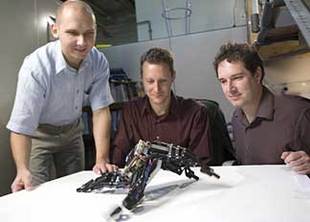
A Robot that can repair itself. More than that; it can adapt to problems, albeit simple ones, and find a solution. Soon (meaning decades) we will have robots that conform themselves to the assigned task on the fly. Imagine the benefits in space and planetary exploration. No more waiting for Earth to tell it what to do.
From Physorg website.Nothing can possibly go wrong ... go wrong ... go wrong ... The truth behind the old joke is that most robots are programmed with a fairly rigid "model" of what they and the world around them are like. If a robot is damaged or its environment changes unexpectedly, it can't adapt.
So Cornell researchers have built a robot that works out its own model of itself and can revise the model to adapt to injury. First, it teaches itself to walk. Then, when damaged, it teaches itself to limp.
Although the test robot is a simple four-legged device, the researchers say the underlying algorithm could be used to build more complex robots that can deal with uncertain situations, like space exploration, and may help in understanding human and animal behavior.
The research, reported in the latest issue (Nov. 17) of the journal Science, is by Josh Bongard, a former Cornell postdoctoral researcher now on the faculty at the University of Vermont, Cornell graduate student Viktor Zykov and Hod Lipson, Cornell assistant professor of mechanical and aerospace engineering.
Instead of giving the robot a rigid set of instructions, the researchers let it discover its own nature and work out how to control itself, a process that seems to resemble the way human and animal babies discover and manipulate their bodies. The ability to build this "self-model" is what makes it able to adapt to injury.
"Most robots have a fixed model laboriously designed by human engineers," Lipson explained. "We showed, for the first time, how the model can emerge within the robot. It makes robots adaptive at a new level, because they can be given a task without requiring a model. It opens the door to a new level of machine cognition and sheds light on the age-old question of machine consciousness, which is all about internal models."
The robot, which looks like a four-armed starfish, starts out knowing only what its parts are, not how they are arranged or how to use them to fulfill its prime directive to move forward. To find out, it applies what amounts to the scientific method: theory followed by experiment followed by refined theory.
It begins by building a series of computer models of how its parts might be arranged, at first just putting them together in random arrangements. Then it develops commands it might send to its motors to test the models. A key step, the researchers said, is that it selects the commands most likely to produce different results depending on which model is correct. It executes the commands and revises its models based on the results. It repeats this cycle 15 times, then attempts to move forward.
"The machine does not have a single model of itself -- it has many, simultaneous, competing, different, candidate models. The models compete over which can best explain the past experiences of the robot," Lipson said.
The result is usually an ungainly but functional gait; the most effective so far is a sort of inchworm motion in which the robot alternately moves its legs and body forward.
Once the robot reaches that point, the experimenters remove part of one leg. When the robot can't move forward, it again builds and tests 16 simulations to develop a new gait.
The researchers limited the robot to 16 test cycles with space exploration in mind. "You don't want a robot on Mars thrashing around in the sand too much and possibly causing more damage," Bongard explained.
The underlying algorithm, the researchers said, could be applied to much more complex machines and also could allow robots to adapt to changes in environment and repair themselves by replacing parts. The work also could have other applications in computing and could lead to better understanding of animal cognition. In a way, Bongard said, the robot is "conscious" on a primitive level, because it thinks to itself, "What would happen if I do this?"
"Whether humans or animals are conscious in a similar way -- do we also think in terms of a self-image, and rehearse actions in our head before trying them out -- is still an open question," he said.
Source: Cornell University
Wednesday, November 15, 2006
50 Interesting Science Facts
50 Interesting Science Facts
From Immense World website.
1 – The speed of light is generally rounded down to 186,000 miles per second. In exact terms it is 299,792,458 m/s (equal to 186,287.49 miles per second).
2 – It takes 8 minutes 17 seconds for light to travel from the Sun’s surface to the Earth.
3 – 10 percent of all human beings ever born are alive at this very moment.
4 – The Earth spins at 1,000 mph but it travels through space at an incredible 67,000 mph.
5 – Every year, over one million earthquakes shake the Earth.
6 – When Krakatoa erupted in 1883, its force was so great it could be heard 4,800 kilometers away in Australia.
7 – Every second around 100 lightning bolts strike the Earth.
8 – Every year lightning kills 1000 people.
9 – In October 1999 an Iceberg the size of London broke free from the Antarctic ice shelf .
10 – If you could drive your car straight up you would arrive in space in just over an hour.
11 – Human tapeworms can grow up to 22.9m.
12 – The Earth is 4.56 billion years old…the same age as the Moon and the Sun.
13 – The dinosaurs became extinct before the Rockies or the Alps were formed.
14 – Female black widow spiders eat their males after mating.
15 – When a flea jumps, the rate of acceleration is 20 times that of the space shuttle during launch.
16 – If our Sun were just inch in diameter, the nearest star would be 445 miles away.
17 – Astronauts cannot belch – there is no gravity to separate liquid from gas in their stomachs.
18 – The air at the summit of Mount Everest, 29,029 feet is only a third as thick as the air at sea level.
19 – One million, million, million, million, millionth of a second after the Big Bang the Universe was the size of a …pea.
20 – DNA was first discovered in 1869 by Swiss Friedrich Mieschler.
21 – The molecular structure of DNA was first determined by Watson and Crick in 1953.
22 – The first synthetic human chromosome was constructed by US scientists in 1997.
23 – The thermometer was invented in 1607 by Galileo.
24 – Alfred Nobel invented dynamite in 1866.
25 – Wilhelm Rontgen won the first Nobel Prize for physics for discovering X-rays in 1895.
26 – The tallest tree ever was an Australian eucalyptus – In 1872 it was measured at 435 feet tall.
27 – Christian Barnard performed the first heart transplant in 1967 – the patient lived for 18 days.
28 – An electric eel can produce a shock of up to 650 volts.
29 – ‘Wireless’ communications took a giant leap forward in 1962 with the launch of Telstar, the first satellite capable of relaying telephone and satellite TV signals.
30 – The Ebola virus kills 4 out of every 5 humans it infects.
31 – In 5 billion years the Sun will run out of fuel and turn into a Red Giant.
32 – Giraffes often sleep for only 20 minutes in any 24 hours. They may sleep up to 2 hours (in spurts – not all at once), but this is rare. They never lie down.
33 – There are 60,000 miles of blood vessels in the human body.
34 – An individual blood cell takes about 60 seconds to make a complete circuit of the body.
35 – On the day that Alexander Graham Bell was buried the entire US telephone system was shut down for 1 minute in tribute.
36 – The low frequency call of the humpback whale is the loudest noise made by a living creature.
37 – A quarter of the world’s plants are threatened with extinction by the year 2010.
38 – Each person sheds 40lbs of skin in his or her lifetime.
39 – At 15 inches the eyes of giant squids are the largest on the planet.
40 – The Universe contains over 100 billion galaxies.
41 – Wounds infested with maggots heal quickly and without spread of gangrene or other infection.
42 – More germs are transferred shaking hands than kissing.
43 – The fastest speed a falling raindrop can hit you is 18mph.
44 – It would take over an hour for a heavy object to sink 6.7 miles down to the deepest part of the ocean.
45 – Around a million, billion neutrinos from the Sun will pass through your body while you read this sentence.
46 – The deepest part of any ocean in the world is the Mariana trench in the Pacific with a depth of 35,797 feet.
47 – Every hour the Universe expands by a billion miles in all directions.
48 – Somewhere in the flicker of a badly tuned TV set is the background radiation from the Big Bang.
49 – Even traveling at the speed of light it would take 2 million years to reach the nearest large galaxy, Andromeda.
50 – A thimbleful of a neutron star would weigh over 100 million tons.
Subscribe to:
Posts (Atom)



 Posts
Posts

